
{ trauma-sensitive support }
I offer trauma-sensitive 1:1 support for people who doubt themselves, who often question themselves and know a loud inner critic.
With a trauma-informed and body-oriented approach, I offer you and your topic space – in my practice in Berlin, in Eberswalde or online, wherever you are.
15-minute introductory call • 100% free of charge • via Zoom or phone • with me personally
Now is the time to embody your true self.

Simon Karim
Trauma-sensitive companion
Heilpraktiker for Psychotherapy, coach and father
The topic of self-doubt
Hello, dear human, since 2015 I have been supporting women and men who doubt themselves – often because, early on, it wasn’t safe to be fully themselves. Today this shows up as a loud inner critic, as perfectionism or as constantly questioning their own perception.
This costs energy and emotional freedom. In working with me, you can experience: your strength is not a danger to your relationships – it is the foundation for real connection.
Step by step, a self-trust grows that doesn’t depend on praise, achievement or other people’s approval.
When people with self-doubt come to me
A loud inner critic → understanding the voice instead of being driven by it
Constant brooding & double-checking → making decisions that feel right
Perfectionism & pressure to perform → finding a self-worth that doesn’t depend on results
Comparing & “not being enough” → seeing yourself through kinder eyes
Making yourself small & disappearing → taking up space, feeling courage and aliveness
Distrusting your own perception → trusting your body and your intuition again
From constant doubt → back to self-trust
How do you experience your topic?
You can talk to me here, free of charge
and without obligation.


You’re in the right place with me if you …
… go over every conversation again afterwards and ask yourself what you did wrong.
… can hardly accept praise, while criticism echoes for days.
… constantly compare yourself and almost always come off worse.
… put off decisions because you don’t trust your own judgment.
… have high standards for yourself and still never feel good enough.
… know the sentence “Something is wrong with me.”

About the invisible weight
you carry
Perhaps you often ask yourself: “Am I allowed to say that?” … “Was that too much?” … “Should I have put it differently?” … “Do I come across as insecure?” … “Did his reaction have something to do with me?”
You go over conversations again afterwards. You only trust your perception once someone else confirms it. Praise rolls off, criticism sticks. And underneath there is often a quiet feeling of shame.
This isn’t about a lack of discipline or too little self-confidence. You probably learned early on that your genuine impulses – your no, your anger, your needs – put the connection to your caregivers at risk. So you began to distrust yourself instead of trusting yourself. This doubt about your own perception still runs deep today – carried by sentences like: “The way I am, I’m not lovable. I’m too much. Something is wrong with me. I’m not good enough.”
How self-doubt can show itself
Five layers that are connected
1
{ the root }
Self-doubt as a survival strategy
At some point the attachment and nervous system learned: if being authentic means losing love, it is safer to deny yourself.
The result can be constant questioning. You trust your own perceptions less, weigh every word, criticize yourself afterwards and have inner dialogues about how it should have been. You doubt what you feel before you express it – and so cut yourself off from your own life energy.
2
{ shame }
The invisible glue
Shame doesn’t say “I did something wrong.” Shame says: “I am wrong.”
You feel ashamed of your boundaries, your anger, your making yourself small – of everything you do and don’t do.
This shame holds the inner blocks together. It is so deeply anchored that it doesn’t feel like shame – but like normality.
3
{ strategies }
People pleasing and scanning the room
Perhaps you have become a mood scanner. You sense what’s going on in the room before anyone says it.
You learned: if I anticipate what others need, I avoid conflict – and conflict once meant losing safety and affection. This keeps the nervous system in constant tension. If this shows up mainly as saying yes and a lack of boundaries, you’ll find more under Stop people pleasing.
4
{ freeze }
The functional freeze – making yourself small
You take up less space – not only mentally, but physically too. Your voice gets quieter, your presence shrinks.
Your body says unconsciously: “The more invisible I am, the safer I am.”
While you make yourself small, you lose contact with yourself. And at some point the question arises: “Who am I, actually, when I’m not pleasing everyone?”
5
{ suppressed strength }
The anger paradox – the blocked solution
Standing up for yourself takes a healthy portion of anger – your protective energy. But if anger used to be dangerous, you block it.
You feel resentment or frustration, but your inner critic cuts it off to protect you from rejection. The anger then turns inward – as self-devaluation, numbness or exhaustion. I describe in more detail how you can feel this strength again under Support for anger.

You may know …
Over-responsibility for other people’s feelings
You taught yourself: if the other person is unwell, it could be my fault. If the mood is tense, it could be because of me. In this mode we manage and repair other people’s feelings – and lose sight of our own.
Alienation from the body & thought loops
Many people with self-doubt lose access to their body over time. Some become spectators of their own lives, others get lost in thought loops and inner dialogues. This was once a clever emergency solution – today it keeps you stuck in your head.
Feelings of shame and guilt
Self-doubt usually comes with shame and guilt. Those who were shamed early on often take this over themselves: you judge yourself, are hard on yourself and question everything. This can change – there is a path to inner safety, curiosity and trust.
You’ve already understood a lot
and still doubt yourself?
- You’ve read self-help books on self-worth, listened to podcasts, maybe even written to ChatGPT about your doubts.
- Your head is full of clever insights – but they never really reach everyday life and land in the body (!).
- You’ve tried to talk yourself into self-confidence with affirmations, while inside it still feels insecure.
- You’ve tried relaxation and meditation techniques, but the inner critic still speaks up.
- You analyze yourself thoroughly – it gives you control, but not the sense of support you long for.
- Perhaps you’ve also already tried classic behavioral therapy.
- You know full well that your doubts are exaggerated, and yet in crucial moments they feel like the truth.
How I work with self-doubt
in my support
My work is about bringing you back into real contact with yourself –
with your body, your feelings and your heart.
Many of us have learned to want to solve problems in our heads.
But thoughts alone often don’t get us any further. Change happens where you can feel yourself again – where the body, the nervous system and your inner space are included.
I work in a trauma-sensitive, body-oriented and relationship-centered way.
This means:
We don’t only look at what your inner critic says, but also at what it wants to protect you from. I work with NARM® (NeuroAffective Relational Model), depth-psychological knowledge and body awareness.
This way you understand why, in certain situations, you make yourself smaller, freeze or double-check everything countless times – and how your nervous system can find more safety within yourself, step by step.
A central part of my work is connecting with the heart. It is more than a symbol of love – it is your inner compass. When you learn to feel and act from the heart again, a connectedness arises that goes beyond thinking.
I support you in dissolving blocks and in no longer avoiding feelings, but holding and understanding them. We learn to relate to ourselves in a new way. Old emotional charges release, and you come into contact with a deeper peace – a state in which you experience yourself as whole again.
The goal of my work is not to make you “stronger” or more functional on the outside, but safer on the inside. From the inside out. You learn to make new decisions that are good for you – and to let go of protective patterns that have kept you small.


In regular 1:1 sessions, complemented by small body exercises for everyday life, you learn to notice the doubt before it overwhelms you.
Where you used to put yourself down, compassion can arise. Where you constantly double-checked yourself, trust in your own judgment grows.
And where there used to be adapting, space opens up for your own voice.
From adapting to self-trust
What I offer you is not a self-help program with quick fixes.
It is process support that takes your inner system seriously – with four focus areas:

1 Regaining self-trust
Real self-trust often grows from a new contact with oneself – from getting to know one’s own body and feelings. Where emotional states can be met anew and the inner map becomes more familiar and wider, a new capacity, an inner resonance and trust in oneself can emerge.
2 Meeting shame consciously
Meeting shame, guilt and fear gently and integratively – with curiosity, sensing, at one’s own pace. Little by little the unknown becomes more familiar and the threatening less threatening, and one knows oneself a bit better again.
3 Recalibrating the nervous system
An empathic, safe 1:1 contact gives space for the process and for arriving back with oneself. In a safe therapeutic contact, clients can often experience a change in their nervous system. Breathing and body exercises as well as meditations can help to find a way out of constant alarm and restlessness.
4 Loosening old beliefs
“I am too much” and “I am not good enough” can lose their weight when they are met holistically instead of being overwritten with positive thoughts. This prepares the ground for corrective experiences from which new inner beliefs can arise quite naturally.
Seven benefits in working with me
You work
with me personally:
You won’t end up in a big coaching machine, and you will not end up working with someone who, for example, has only just finished a training.
There are also no preliminary calls with “setters” or “sales closers” who tell you all sorts of things just so you stay.
The two of us work together safely and confidentially.
Your individual
space & framework:
In the form of individual support over several weeks or
over several months.
I also have a
clear maximum number
of people
I support, so that I can
guarantee a high standard.
Faster than
trial & error:
Instead of years of trial and error, we go
deeper, directly
to the root – to the nervous system and
the unconscious survival strategies
that formed
long ago.
🤍🗝️🌱
Authenticity
instead of a role:
You do not learn to play a new, strong role.
You can experience, at your own pace, staying so deeply connected to yourself
that your life force and joy feel safe and not like an effort that doesn’t fit, in an everyday life that is so often already full.
A sometimes
paradoxical path:
I won’t push you into action or try to “help” you by any means necessary.
It is about your inner movement and a new capacity that can develop.
I trust
that YOUR solution lies within YOU, I build on my experience from more than
500 clients and use scientifically
grounded methods.
Inner
safety:
When your system learns to feel safe, real strength arises all by itself.
We free the life force that is already
within you, but that is usually still partly blocked by shame, guilt, tension and fear.
I take you
by the hand:
Always at eye level,
with appreciation and full respect.
If you like,
for a short, medium
or longer stretch
of your individual journey of growth as a human being.
“Yesterday I was clever, so I wanted to change the world.
Today I am wise, so I am changing myself.”
{ Rumi }
I offer you space to …
- … get to know your inner critic instead of constantly wrestling with it.
- … explore what still stands in the way of your self-trust today.
- … feel your body again as a reliable compass.
- … make decisions without double-checking them ten times.
- … gently release old shame and the feeling of not being enough.
- … be able to accept again praise, closeness and recognition.
- … show yourself with your strength – and feel safe in it.
Where does the support take place?
Online, in Berlin or in Eberswalde

I support most of my clients online via video – wherever you are, in German or English. In person, we meet in my practice in Berlin between Mitte and Prenzlauer Berg (near Bernauer Straße U-Bahn station) or, by arrangement, in my practice in Eberswalde.
People with strong self-doubt have often learned to make themselves invisible, to pull themselves together or to put up a functioning façade. Here you can set that down – the space is safe, caring and free of judgment.
So far I have supported more than 500 people on their way to more self-trust.
Everything starts with a free introductory call –
15 minutes, via Zoom or phone.
You are welcome just as you are.
“In the midst of winter, I found there was,
within me, an invincible summer.”
Why I support people in coming into their authenticity and strength

The vision of my work is to support people in coming back into real contact with their inner strength – beyond shame, adapting or deep inner holding back.
Blocks and suppressed feelings, such as an old, pushed-away anger or grief, don’t arise by chance.
In most cases, a survival strategy lies beneath them: perhaps at some point it was unconsciously decided that it was better not to ruffle feathers, not to burden anyone, to make oneself small or enormously big, or to become extremely critical of oneself … all of this, ultimately, to receive love.
Many people never learned that anger, for example, can be a healthy force – a force that stands up for clear boundaries, our protection, our position or orientation. I like to call it “anger power” here. Instead, this force was shamed, ignored or punished. And so the contact to it gets lost – and with it, often, the contact to one’s own self. In its place came tension, fear, melancholy or a very critical inner authority.
But it doesn’t have to stay that way. It is possible to release blocks and integrate feelings – so that new capacity and a balanced, clear strength arise that help you stay with yourself.
My work brings together trauma-sensitive, depth-psychologically grounded psychotherapy and a somatic, heart-based mindfulness. We meet old patterns with compassion instead of pressure – and open paths back to aliveness, courage and authenticity.
What is allowed to change in support
for self-doubt
After a few sessions, clients describe, for example, that …
… the inner critic has become quieter – or they no longer take it so seriously.
… they make decisions faster and double-check less.
… they show more of themselves in conversations without overthinking everything afterwards.

Feedback and testimonials
More voices
Feedback from participants

Anonymized feedback
“I feel very liberated – it has become a lot easier to get to know new people and to feel or allow a real connection since I did the mentoring with Simon.
What has changed is also my mindset – but above all the relationship
with myself. From this new, healthier stance toward myself, healthier behavior arises automatically too – and deeper, more authentic relationships on the outside.”

Anonymized feedback
„When I think of Simon, „empathy“ and
„wise“ come to mind. He listens to you,
gives you space, and when you seek him out, he gives you discerning perspectives.
I cherish my coaching journey on „heartfulness and relationship“ with Simon and it feels good to know that i can consult him any time in future again.“
–
The coaching took place in English.
„When I think of Simon, „empathy“ and „wise“ come to mind. He listens to you, gives you space, and when you seek him out, he gives you discerning perspectives. I cherish the coaching journey around „heartfulness and relationship“ with Simon and it feels good to know that i can consult him any time in future again.“
–
The coaching took place in English.

Anonymized feedback
“Through Simon’s spiritual guidance I came into contact with an extraordinarily deep inner peace.
I felt very seen and understood. He has a very sensitive way about him
that made it easy for me to trust him.”

Anonymized feedback
“The 3-month coaching with Simon was one of the important islands in a year full of personal and professional challenges. I now feel more balanced and strengthened inside for whatever may still come. Thank you!”

Anonymized feedback
“Whaaa!! I love how Simon works, … and that’s where it ends, because I don’t actually know how exactly he does it, but in the coaching Simon (together with me) turned my huuuge problem – which had been tormenting me for weeks or months – into a trifle. Simply through one conversation with him, my problem vanished into thin air.
It feels as if he picked me up exactly at the point where I was standing there a bit lost and alone.
I had the feeling I was stagnating. Simon accompanied me for a short stretch and since then I’ve been moving again. 🙂

Anonymized feedback
“Simon is a very sensitive, trauma-sensitive therapist who enabled me to gain deeper insights into myself. His calm, his openness, his expertise in the field of developmental trauma and his experience in the spiritual realm make him an exceptionally competent and humanly approachable coach.”
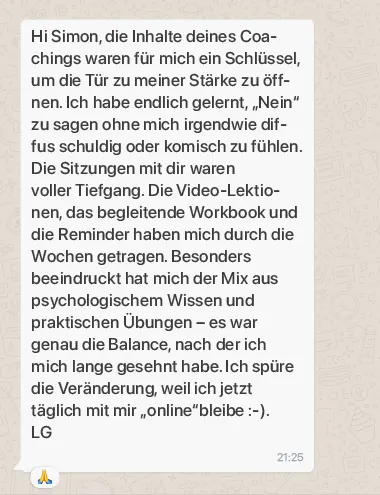
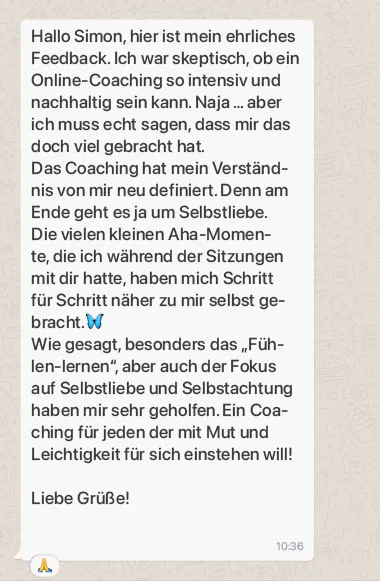
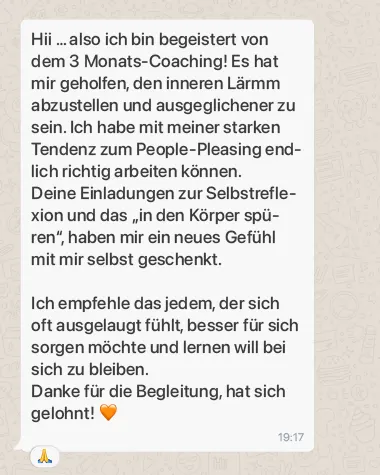
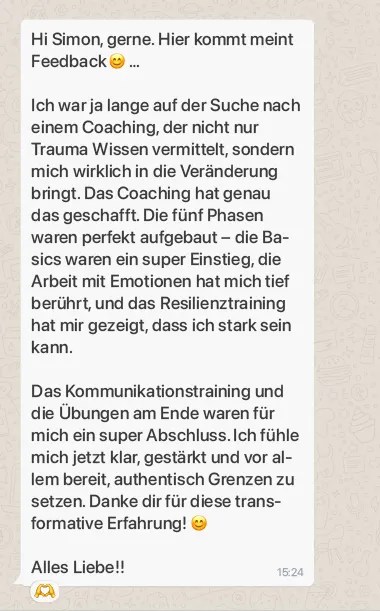
Feedback via WhatsApp
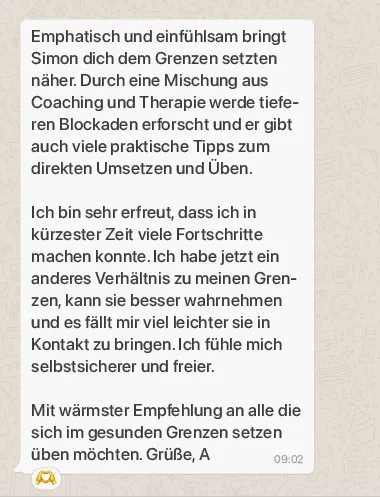
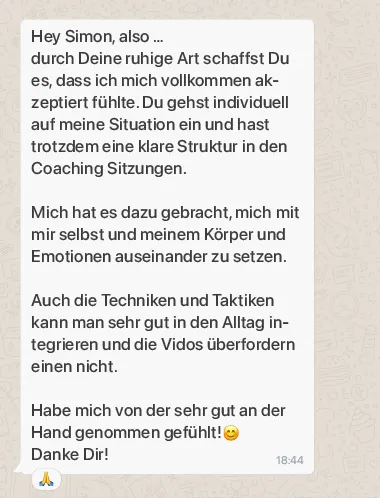
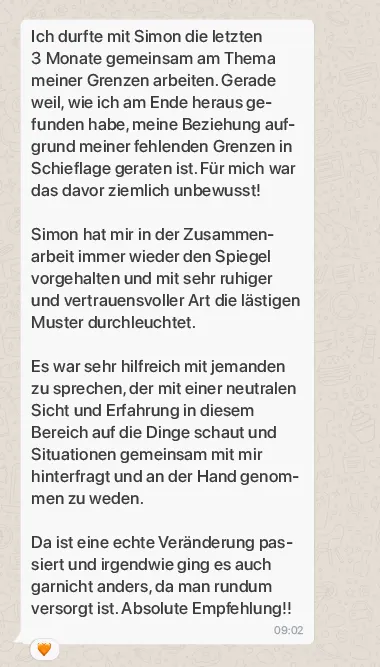
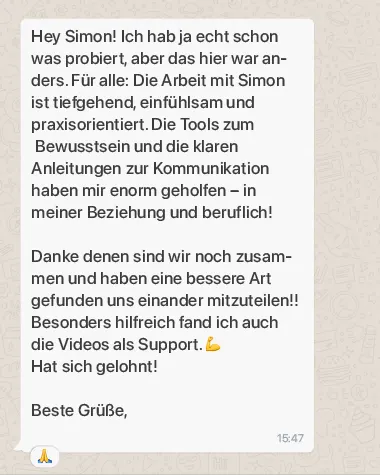
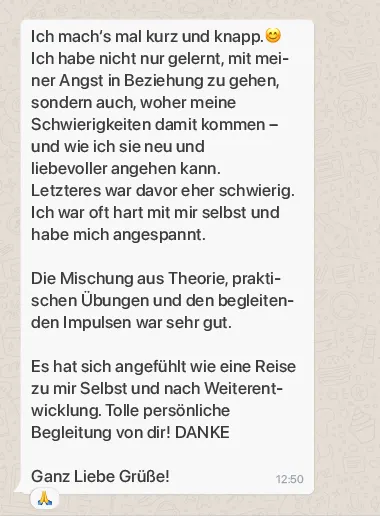
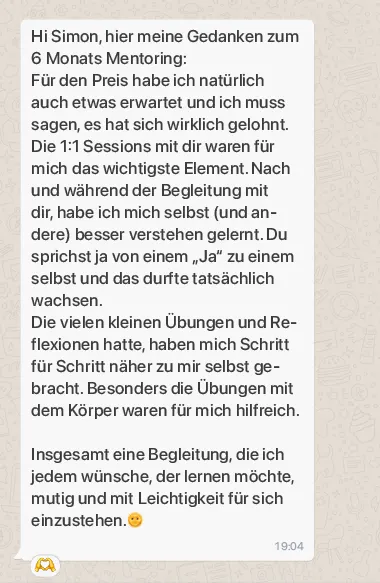

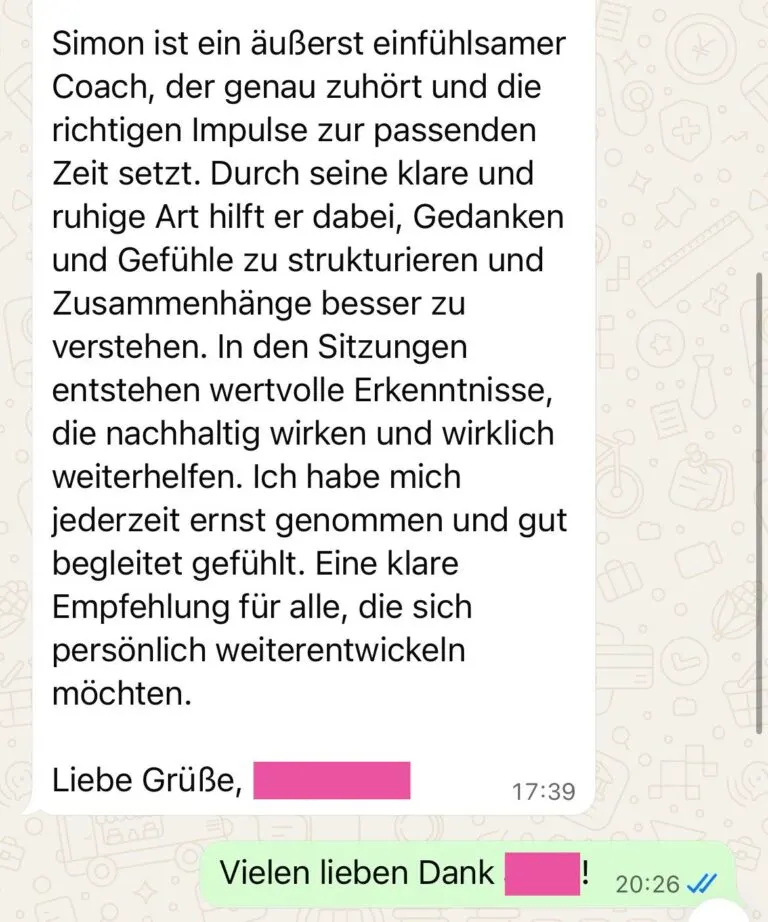
Tap a message to read it.
Written by the client, no compensation, selected by me.
Messages via email
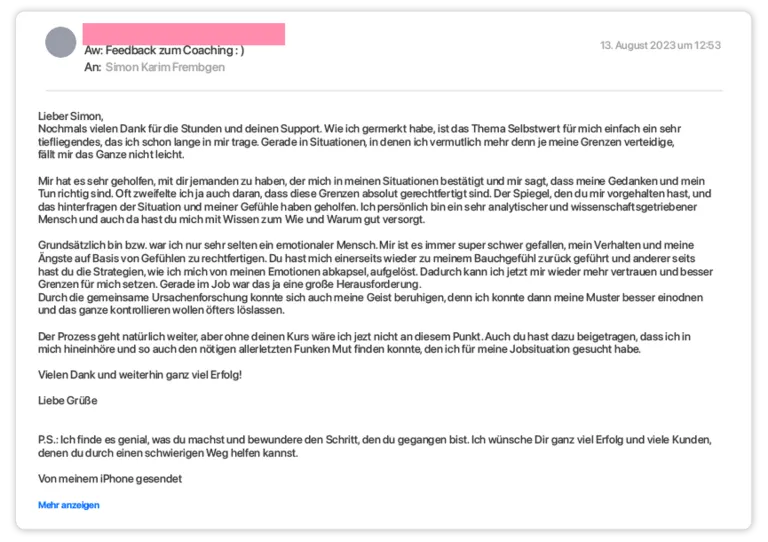
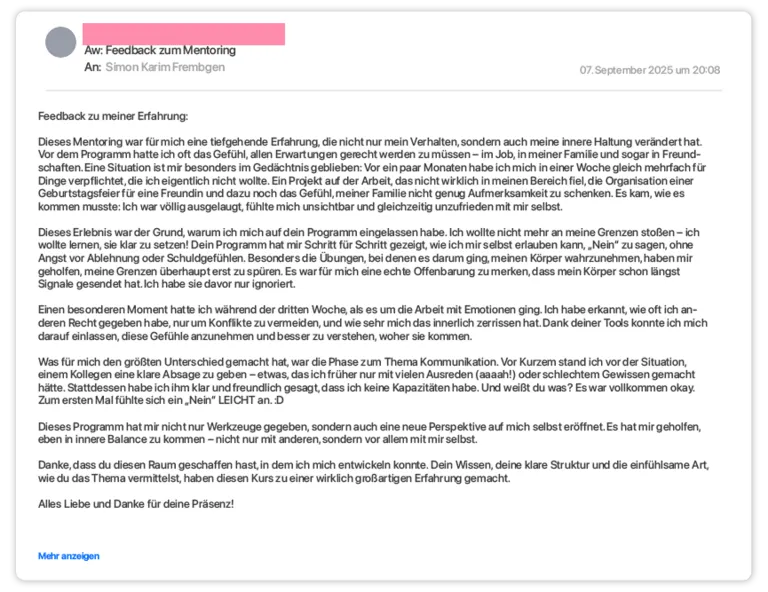
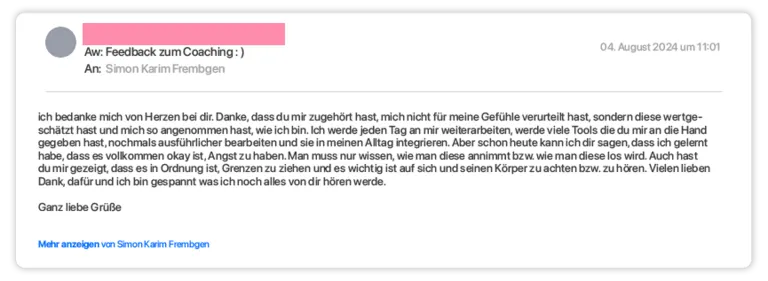
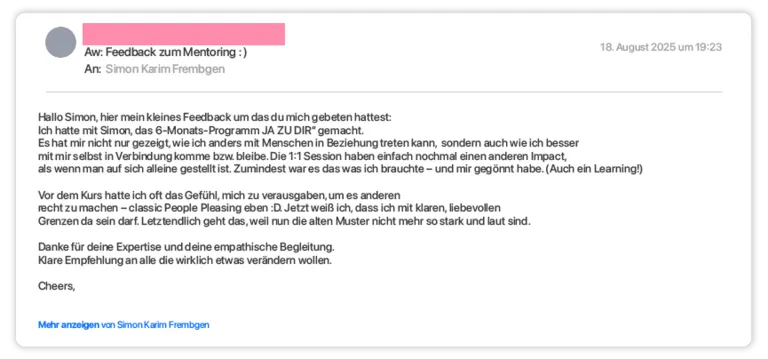
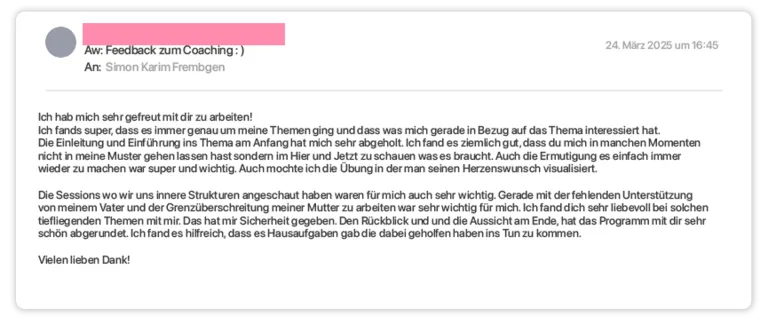
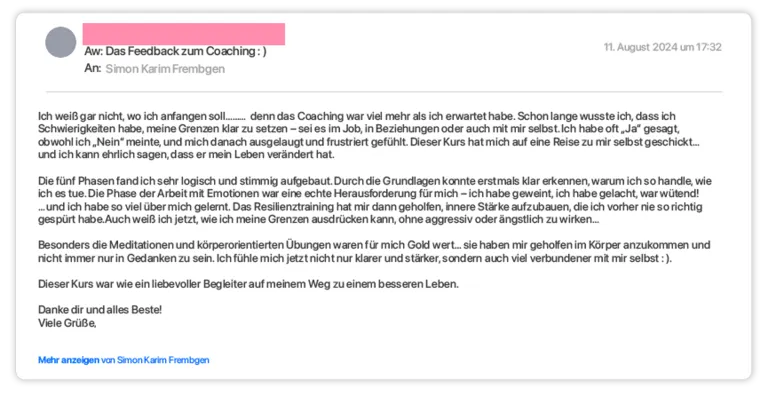
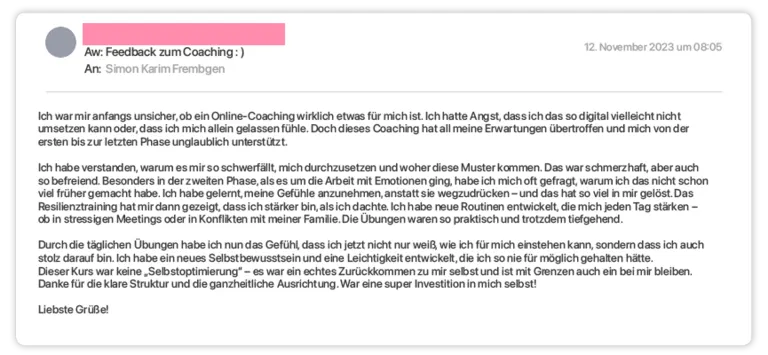
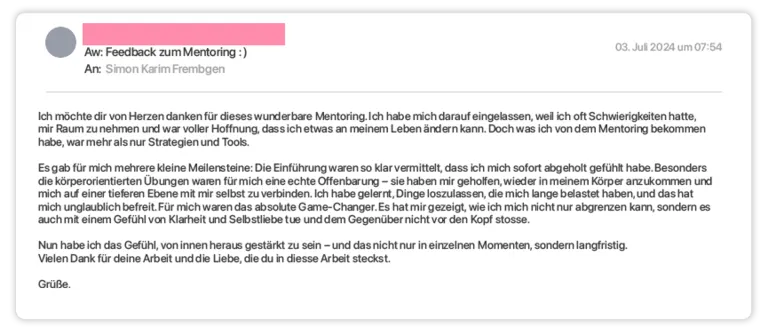
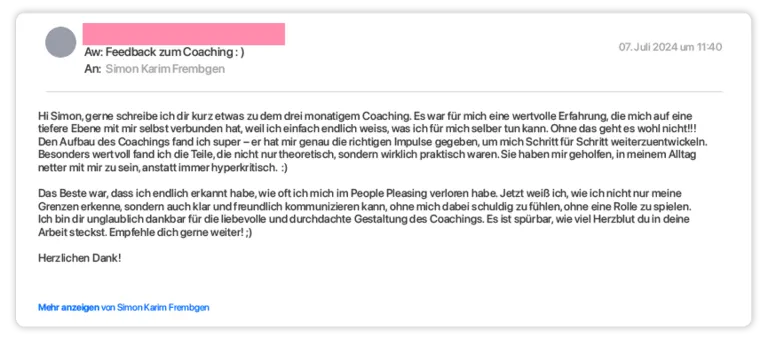
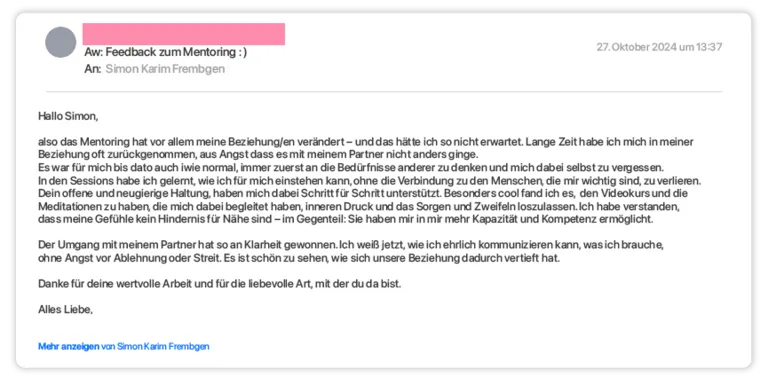
Tap a message to read it.
Written by the client, no compensation, selected by me.
The testimonials were written by clients voluntarily and without any compensation, and were selected by me. They reflect personal individual experiences and are not a promise of any particular course or outcome.
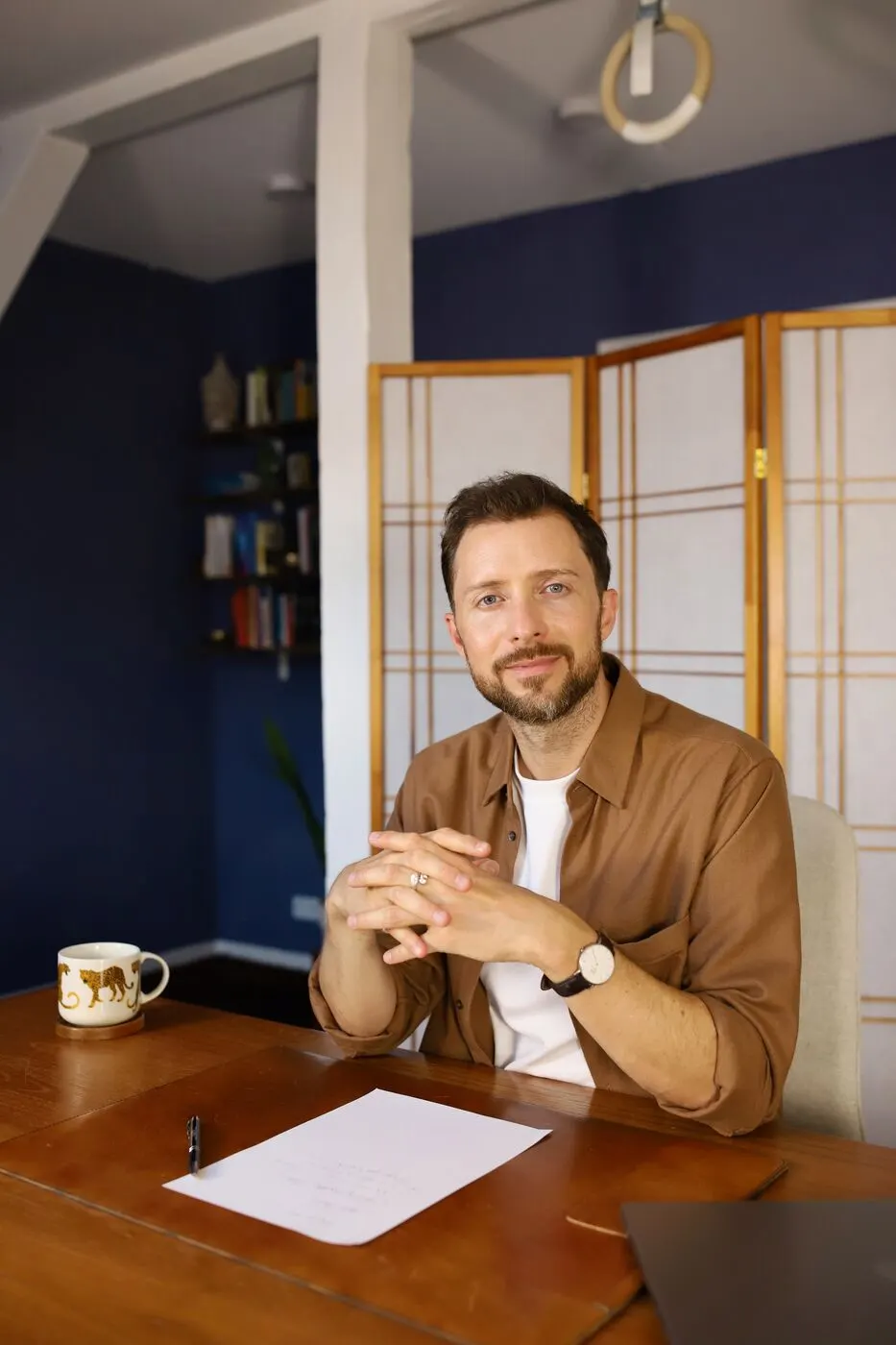
About me
About me
For many years I have been supporting people on their path through developmental trauma,
self-doubt and relationship dynamics. My background combines NARM® trauma therapy,
Gestalt therapy, depth-psychological psychotherapy and bodywork – always with heart,
humor, respect, directness, eye level and depth.
For many years I have been
supporting people on their path
through developmental trauma,
self-doubt and relationship dynamics.
My background combines NARM® trauma therapy,
Gestalt therapy, depth-psychological psychotherapy and
bodywork – with heart,
humor, respect, directness, eye level and depth.
More about my path
{ a personal message }
In my mid-to-late twenties I went through something
that felt like meaninglessness and groundlessness.
Burnout, overwhelm – and underneath a gnawing self-doubt that colored everything I did.
I remember this paralyzing inner state: on the outside I functioned, but inside I was constantly asking – is what I’m doing good, confident, intelligent, attractive enough?
Am I even good enough? And the big sentence that shaped me back then: something is wrong with me. I know what it’s like not to trust your own thoughts. What it’s like, on the one hand, to put a lot of energy into achievement – ever higher, ever better – and on the other hand to feel deep inside: it’s never enough.
I also know what it’s like when this doubt
is at work in relationships. When you wonder
whether you are too much or too little.
Whether you deserve to be loved.
Whether the other person can really see you –
or only a façade you have built.
This self-doubt – it wasn’t bad.
It was a form of survival.
A caution my nervous system offered me to protect me.
Only when I began to feel myself again – to listen to my body, to give the old patterns space instead of pushing them away – did something fundamental change.
I didn’t learn to switch off the doubt.
That was never the goal. Instead, I learned to understand it. To listen to it without being driven by it. And very slowly something else came:
A calm, quiet certainty.
A contact with myself that doesn’t depend on achievement, outside approval or avoidance.
Today I can say – and I don’t mean this romantically – that this doubt led me into depth. It was a gateway. This experience has fundamentally shaped my work.
Since 2015 I have been supporting people
who, among other things, carry self-doubt – whether it shows up
as paralysis or as restless over-adapting.
People who keep questioning
whether they’re “doing it right”, whether they deserve it.
Who sense that something true lies hidden beneath this doubt – but don’t know how to reach it.
If this sentence has ever haunted you – “Something is wrong with me” – or if
you notice that your self-doubt gets in your way in relationships,
in decisions or simply in living
life itself:
This is exactly what I can offer you space for.
Lovely that you’re here!
🤍🗝️🌱
Frequently asked questions
What is support for self-doubt?
Support for self-doubt is a 1:1 process in which you understand where your constant questioning comes from and, step by step, develop more trust in yourself.
I work in a trauma-sensitive way with NARM® and include the body and nervous system – because self-doubt rarely sits only in the head.
Where does strong self-doubt come from?
Strong self-doubt is usually an early protective strategy. If, as a child, it wasn’t safe to be there with all your feelings, needs or a clear no, the nervous system learns: it is safer to distrust yourself.
This gives rise to sentences like “I’m not good enough” or “Something is wrong with me”. They feel true, but they are learned – and that is why they can change.
Can I get rid of my inner critic?
No – and that isn’t the goal either. The inner critic once protected you, for instance from rejection or being shamed.
In the support you learn to recognize it, understand its message and no longer let it steer you. Many experience that, over time, it becomes quieter as a result.
What is the difference between this support and psychotherapy?
My trauma-sensitive support is not psychotherapy covered by health insurance. I am a Heilpraktiker for Psychotherapy and a certified NARM® therapist; in Germany, NARM is not one of the therapy methods approved for reimbursement by health insurance.
The focus is on your experience in the here and now, your resources and your nervous system – not diagnoses. If a mental illness is in the foreground, medical or psychotherapeutic treatment is the right first step.
How does support for self-doubt work?
It starts with a free introductory call (15 minutes, via Zoom or phone). There we clarify what matters to you and whether we are a good fit.
After that we work in individual sessions of 50 or 90 minutes, in person or online via video. We agree on the right length and rhythm together.
How many sessions make sense for self-doubt?
Most support processes comprise around 8 to 20 sessions. How many it will be for you depends on how deeply the doubts are anchored and what you set out to do.
We discuss the framework in the introductory call; you decide for yourself whether and how long you want to continue.
Does the support take place online or in person?
Both are possible. In person, I work in my practice in Berlin (Rheinsberger Straße 37, near Bernauer Straße U-Bahn station) and, by arrangement, in my practice in Eberswalde.
Online, I work via video, wherever you are and in German or English. Many of my clients work with me exclusively online.
What does support for self-doubt cost?
The introductory call is free. The fees depend on income; you’ll get an overview in the introductory call.
Private health insurance reimburses Heilpraktiker services in part, depending on the plan; statutory health insurance does not cover them.
I don’t even trust myself to get in touch. Is that normal?
Yes. Exactly this hesitation is part of self-doubt – the worry of not being “bad enough off” or of stealing other people’s time.
You don’t need to prepare anything or prove anything. In the introductory call you can simply tell me how you are; we’ll figure out the rest together.
Who is the support not suitable for?
It is not suitable in acute crises and with severe mental illnesses, for example acute psychoses, severe depression that requires medication or inpatient treatment, acute addiction or suicidal thoughts.
In that case, seeing a medical specialist or a licensed psychotherapist is the most important first step. In an acute crisis you can reach the TelefonSeelsorge (German crisis helpline) around the clock at 0800 111 0 111, in an emergency call 112.

Your next step
Do you feel it’s time to stop letting your inner critic have the last word?
Then let’s talk …
15 min. · 100% free · via Zoom or phone · with me personally