
Making the repressed conscious
Gestalt therapy is a humanistic, experience-oriented approach that puts perceiving and feeling in the here and now at the center. It is suitable for people who want to sense themselves better, understand recurring patterns and engage in contact with others in a more alive way. In my support in Berlin and online, I use elements of Gestalt therapy, combined with NARM® and body awareness.
Gestalt therapy: a path to yourself
Gestalt therapy is a psychotherapeutic method founded in the 1950s by Fritz and Laura Perls and Paul Goodman. It belongs to humanistic psychotherapy and is based on a holistic view of the human being: body, soul and mind are inseparably connected – embedded in social, family and ecological contexts.
The person is not seen as “deficient”, but as someone who carries their own solutions within – when they come back into real contact with themselves.
“Lose your mind and come to your senses.”
{ Fritz Perls }
What is Gestalt therapy?
Instead of just analyzing problems, we look together at what is alive in the moment:
- What feelings are there – even if they contradict each other?
- What inner movements show up in the body?
- What is suppressed, overlooked or held back?
- And how can you come back into contact with yourself at your own pace?
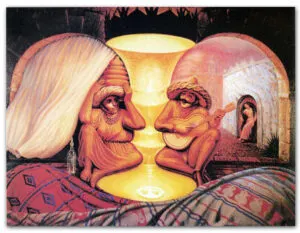
“Gestalt” means: the whole is more than the sum of its parts. Our perception forms meaningful units – outside as well as inside.
Just as a figure suddenly emerges from thousands of dots on woodchip wallpaper, a feeling arises from sensations, impulses and thoughts – for example hunger, anger or loneliness.
Gestalt therapy helps you to consciously perceive these inner signals – so that you know again what you need, who you are and how you can stand up for yourself.

How I work with Gestalt therapy
Gestalt therapy is about experience, not just insight. In my practice I work with:
- presence in the here and now
- dialogical encounter on an equal footing
- experiments, body awareness and honest communication
- exploring inner patterns, feelings and “life scripts” or beliefs
You recognize how roles learned early on – for example “I’m not allowed to feel” or “I’m not important” – still influence you today. And you begin to try out new ways, beyond adapting or denying yourself.
The Gestalt prayer as a daily reminder
I have designed Fritz Perls’ famous Gestalt prayer as a graphic in a slightly modified form.
The Gestalt prayer is nothing religious. It is a positive affirmation that speaks to your autonomy and self-efficacy in a healthy way. This attitude also shapes my individual sessions and groups.

Influences and attitude
I was shaped by my training in depth psychological and existential psychotherapy, in which Gestalt therapy had an important place. In my courses and in my practice, I repeatedly use approaches from Gestalt therapy.
I combine this approach with:
- NARM® (NeuroAffective Relational Model)
- resource-oriented therapy
- embodiment and bodywork
- honesty work (Radical Honesty, Deep Honesty)
- creative media such as painting and creating
- meditation and spiritual consciousness work (Advaita Vedanta)
Who is this work for?
- For people who are stuck in old patterns and feel cut off inside
- For anyone seeking more access to their feelings, impulses and needs
- For people with physical stress reactions or chronic tension
- For people who long for depth, honesty and real connection
- For you, if you have the feeling: “I function – but I’m not really living”

Where you experience Gestalt work with me
Gestalt therapy elements flow into my individual support – whenever it helps to move from talking into experiencing:
- Trauma-sensitive coaching in Berlin – in the practice between Mitte and Prenzlauer Berg there is room for experiments, movement and body awareness in direct contact.
- Trauma-sensitive coaching online – presence in the here and now also works via video, in German or English.
- Burnout coaching – when you are only functioning and have lost contact with your own signals.
Closely related is the work with creative media, which makes inner images visible through painting and creating. Further reading: The relationship with yourself.

Frequently asked questions about Gestalt therapy
What happens in a Gestalt therapy session?
We begin with whatever is present in you right now – a thought, a feeling, a tension in the body. Instead of only talking about it, small experiments invite you to experience it directly: saying a sentence out loud, following a movement or giving an inner part a voice.
The rule is: everything is an offer. You decide what you would like to try.
What is an “experiment” in Gestalt therapy?
An experiment is a small, playful exercise that arises from the moment. For example, you speak to an empty chair on which you place a person in your mind, or you exaggerate a gesture to feel what is in it. There is no right or wrong – it is about noticing something new about yourself.
What does “unfinished gestalt” mean?
This is what Gestalt therapy calls experiences that could not be completed: an unspoken word, a goodbye that never happened, an anger that had no place. Such open issues bind energy and often resurface in new situations. In our work together, we give them space so that they can find closure.
How does Gestalt therapy differ from NARM®?
Both work in the here and now and include the body. Gestalt therapy relies strongly on awareness, contact and the experiment. NARM® is specifically focused on developmental trauma and looks at how early survival strategies shape your connection to yourself and others today.
I am a certified NARM® therapist and use Gestalt elements where they make the work more alive.
Is this psychotherapy billed to health insurance?
No. I work as a Heilpraktiker for Psychotherapy (licensed non-medical psychotherapist in Germany) outside the health insurance system and use elements of Gestalt therapy in my support. If you are looking for psychotherapy paid for by health insurance, please contact licensed psychotherapists. In an acute crisis, you can reach the TelefonSeelsorge (German crisis helpline) at 0800 111 0 111; in an emergency, call 112.
How do I get started?
You fill out a short questionnaire, and then we briefly arrange an appointment. In the free introductory call (15 minutes, via Zoom or phone) we then look together at what you wish for and whether the work fits you.
If you are curious about what becomes possible through real presence, contact and inner truth:
🤍🗝️🌱